YOU ARE THE WHAT-SHAPED WHAT: UNDERSTANDING THE POETIC GENRE THROUGH A SELF-REFLEXIVE READING OF CHILD-AUTHORED POEMS
Name
Yifei Yang
Major
Global Cultural Studies / World Literature
Class
2023
About
Name: Yifei Yang
Class: Undergraduate Class of 2023
Major: Global Cultural Studies - World Literature
Signature Work Project Overview
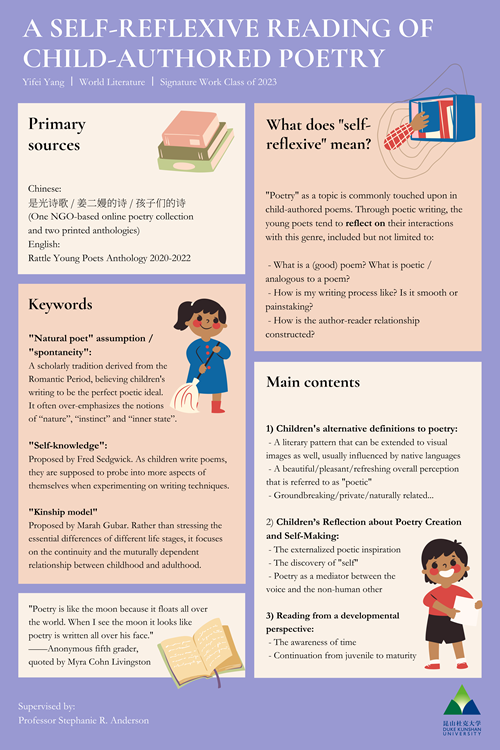
Young poets and child-authored poetry are often regarded as “mysterious” and “spontaneous” in the Romantic literary tradition, and such a myth continues to influence the circulation of child-authored poems in a crosscultural context. The proponents of children’s spontaneity often associate their poetry writing with a desire for “self-expression”, namely the autonomous revelations of children’s inner worlds. By contrast, this paper argues that the assumption on spontaneity shows a certain degree of inconsistency, for the emphasis on “nature” and the external “secrets of the universe” contradicts with the culturally embedded development of the “self”. Based on Myra Cohn Livingston’s observation on the historical construction of the “natural poet” myth and Fred Sedgwick’s notion of “self knowledge” acquired through children’s poetry writing practice, this paper studies the reflections on poetry creation from children’s poetry anthologies in Chinese and English, with special focus on their definition of poetry, their vivid subjective experiences of “self-expression” and their poetic representation of time and development. The sample texts show that young poets tend to define the poetic genre largely through reflecting on their emotional experiences, and their “self knowledge” is enhanced through constant experimentation on texts. Poetry writing serves as the very mediator between children’s internal and external worlds, between the self and the other and among different life stages. Although this paper does not have a unified conclusion, it offers a unique angle in addition to pedagogical implications, by utilizing close-reading techniques and analyzing child-authored poetry from a literary history perspective.