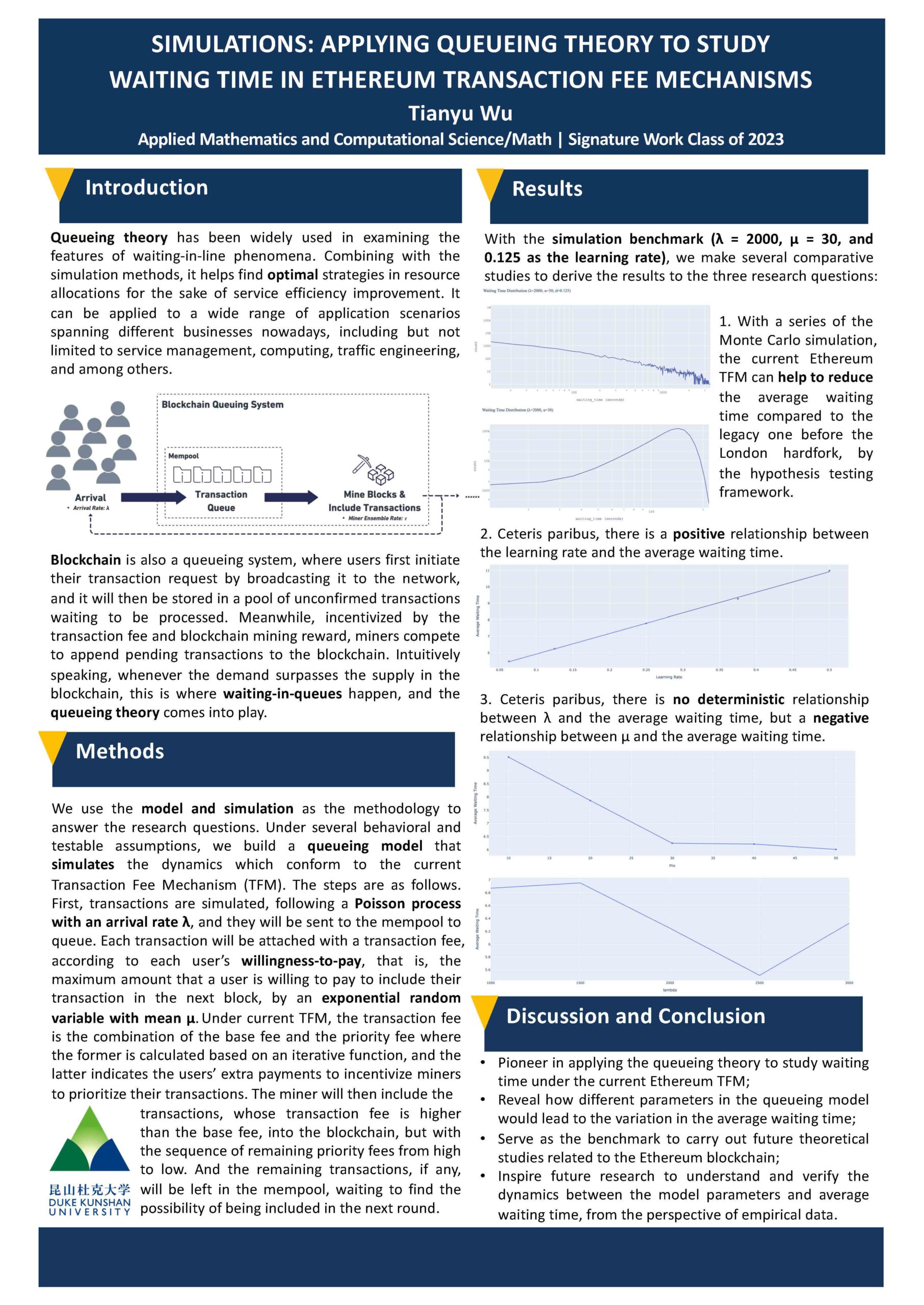
Simulations: Applying Queueing Theory to Study Waiting Time in Ethereum Transaction Fee Mechanisms
Name
Tianyu Wu
Major
Applied Mathematics and Computational Science
Class
2023
About
Hi! This is Tianyu Wu, a senior-year student majoring in applied mathematics and computational science at DKU. I originally come from Nantong, China.
Signature Work Project Overview
Queueing theory has a history of more than one hundred years. It serves as the foundation for examining the features of waiting-in-line phenomena and can help find optimal strategies in resource allocation for the sake of service efficiency improvement. Queueing theory has wide application scenarios, spanning different industries. With the rapid development of blockchain recently, this SW project aims to apply the queueing theory to understand blockchain dynamics, as blockchain is a decentralized queueing system where transactions are sent to a pool of unconfirmed queues, awaiting to be processed by the miners. However, none of the existing research managed to apply the queueing theory to understand the dynamics of pending transactions in the Ethereum blockchain. In this paper, we build a queueing model based on the current Ethereum Transaction Fee Mechanism (TFM) and manage to reveal that the current Ethereum TFM can help to reduce the average waiting time compared to the legacy one before the London hardfork. Furthermore, our study shows that the average waiting time is positively correlated with the learning rate, specified in the TFM base fee adjustment mechanism, and negatively correlated with users’ willingness to pay, but no deterministic relationship with the transaction arrival rate. Our research also inspires future research to apply queueing theory to optimize the Ethereum TFM through variations of the relevant parameters.