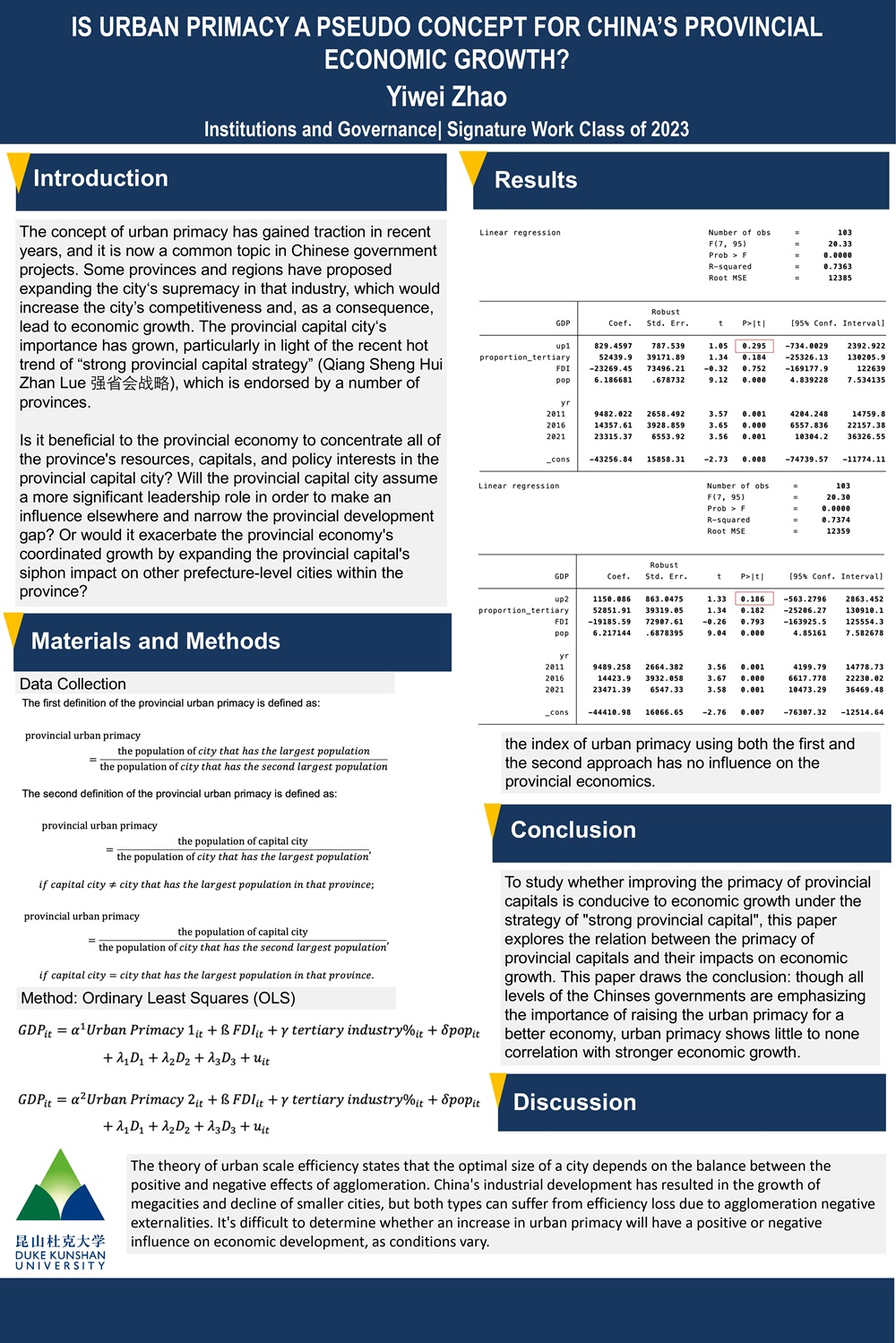
IS URBAN PRIMACY A PSEUDO CONCEPT FOR CHINA’S PROVINCIAL ECONOMIC GROWTH?
Name
Yiwei Zhao
Major
Institutions and Governance / Economics
Class
2023
About
Yiwei is a student majored in Institutions and Governance, with the track of Economics. In this E-portfolio, she introduces her signature work product
Signature Work Project Overview
The idea of urban primacy has gained popularity in recent years and is now a frequent theme in Chinese government initiatives. To expand the city’s dominance in that field, several provinces and regions have suggested, which would boost the city’s competitiveness and, as a result, lead to economic growth. The importance of the provincial capital city has increased, especially in light of the recent hot trend of “strong provincial capital strategy” (Qiang Sheng Hui Zhan Lue 强省会战略), which is being supported by a number of provinces. Is it advantageous for the provincial economy to concentrate all of the resources, capitals, and policy priorities in the provincial capital city? Will the provincial capital city take on a more powerful leadership position to have an impact elsewhere and close the development gap inside the province? Or would it worsen the coordinated growth of the provincial economy by increasing the siphon effect of the provincial capital on other prefecture-level cities within the province? In this research, a quantitative analysis of ordinary linear regression will be implemented, and the author finds out that the concept of urban primacy actually has no significance for provincial economic growth.