Is China’s Comprehensive Smoke-free Policy Effective? A Synthetic Difference-in-Differences Analysis in Beijing
Name
Yichen Fang
Major
Global Health / Public Policy
Class
2023
About
Is China's Comprehensive Smoke-free Policy Effective? A Synthetic Difference-in-Differences Analysis in Beijing
Signature Work Project Overview
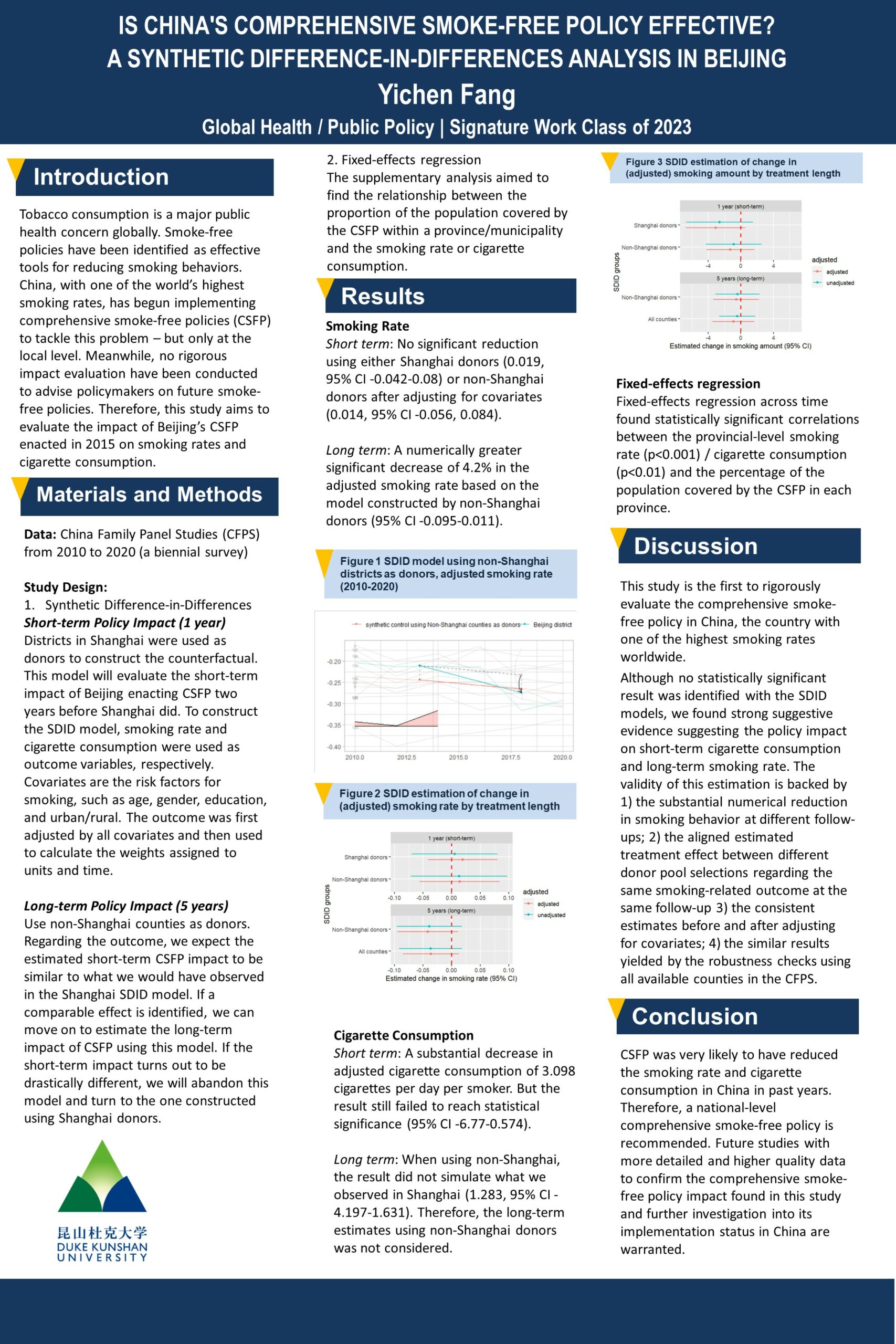
Tobacco consumption is a major public health concern globally. Smoke-free policies have been identified as effective tools for reducing smoking behaviors. China, with one of the world’s highest smoking rates, has begun implementing comprehensive smoke-free policies (CSFP) to tackle this problem – but only at the local level. Meanwhile, no rigorous impact evaluation has been conducted to advise policymakers on future smoke-free policies. Therefore, this study evaluates the impact of Beijing’s CSFP on smoking rates and cigarette consumption using a synthetic difference-in-differences design. Although primary analyses do not yield statistically significant results, we find strong suggestive evidence that the policy yielded a positive impact on reducing short-term cigarette consumption and long-term smoking rates. Varying donor pools and adjusting county-level covariates do not affect our results, bolstering confidence in their validity. Additionally, fixed-effects regression analysis reveals a statistically significant negative correlation between province-level CSFP coverage and smoking rates and cigarette consumption over time, providing solid support. These findings call for a national-level CSFP to improve population health; they also highlight the importance of studying effective policy implementation.