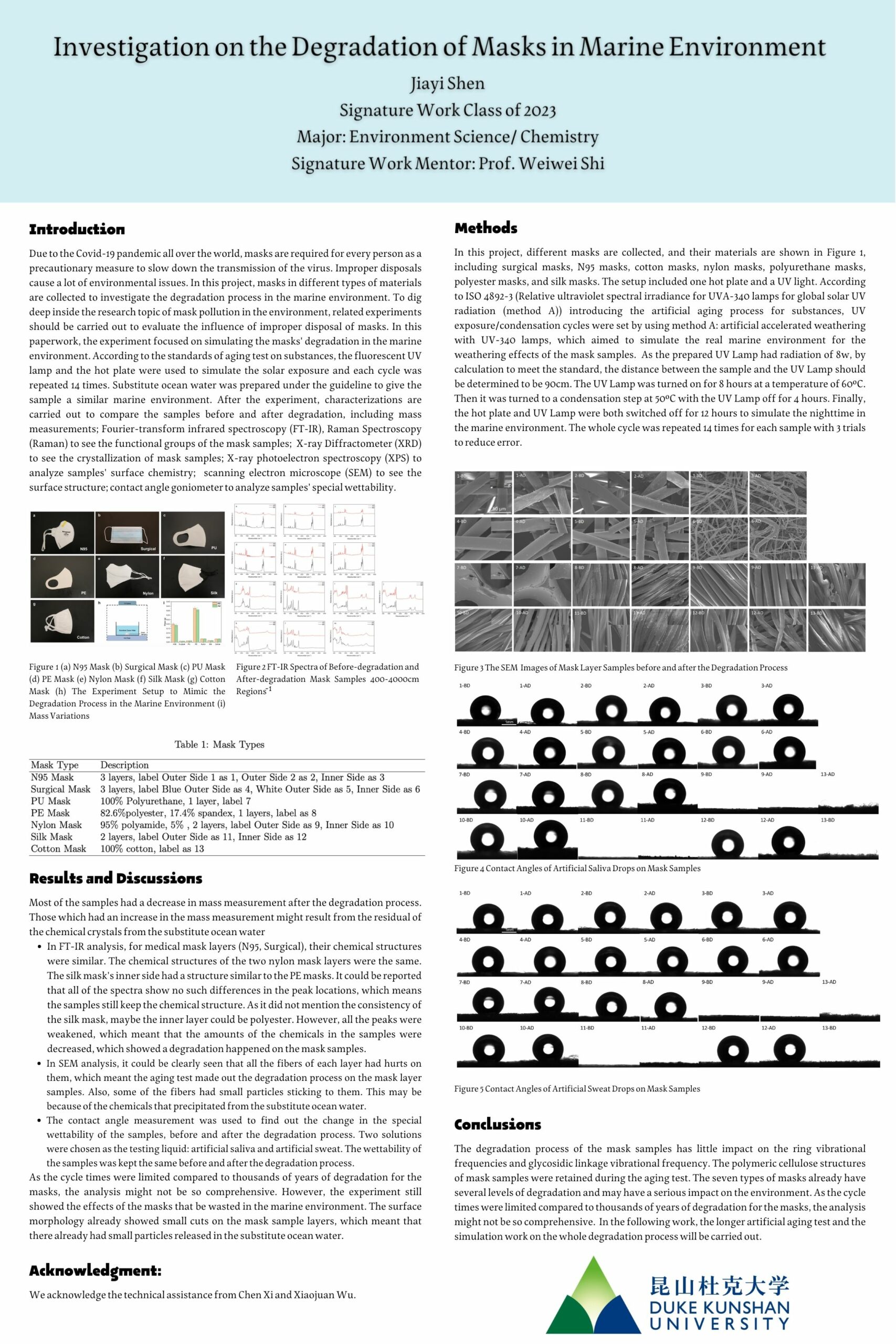
Investigation on the Degradation of Masks in Marine Environment
Name
Jiayi Shen
Major
Environmental Science / Chemistry
Class
2023
About
Jiayi Shen is a native of Shanghai studying Environment Science and Chemistry. Jiayi will pursue a Master of Science in Chemical Engineering.
Signature Work Project Overview
Due to the Covid-19 pandemic all over the world, masks are required for every person as a precautionary measure to slow down the transmission of the virus. Improper disposals cause a lot of environmental issues. In this project, masks in different types of materials are collected to investigate the degradation process in the marine environment. To dig deep inside the research topic of mask pollution in the environment, related experiments should be carried out to evaluate the influence of improper disposal of masks. This work simulated the marine environment to figure out the degradation process of seven types of masks. Substitute ocean water was prepared under the guideline to give the sample a similar marine environment. After the experiment, characterizations are carried out to compare the samples before and after degradation, including mass measurements; Fourier-transform infrared spectroscopy, Raman Spectroscopy to see the functional groups of the mask samples; X-ray Diffractometer to see the crystallization of mask samples; X-ray photoelectron spectroscopy to analyze samples’ surface chemistry; scanning electron microscope to see the surface structure; contact angle goniometer to analyze samples’ special wettability. The degradation process of the mask samples has little impact on the ring vibrational frequencies and glycosidic linkage vibrational frequency. The polymeric cellulose structures of mask samples were retained during the aging test.