Interpretable Autoencoder Application in Industrial Anomaly Detection
Name
Rui Jiang
Major
Data Science
Class
2023
About
Rui Jiang majors in Data Science at Duke Kunshan University. Her academic interest is in machine learning and neural network.
Signature Work Project Overview
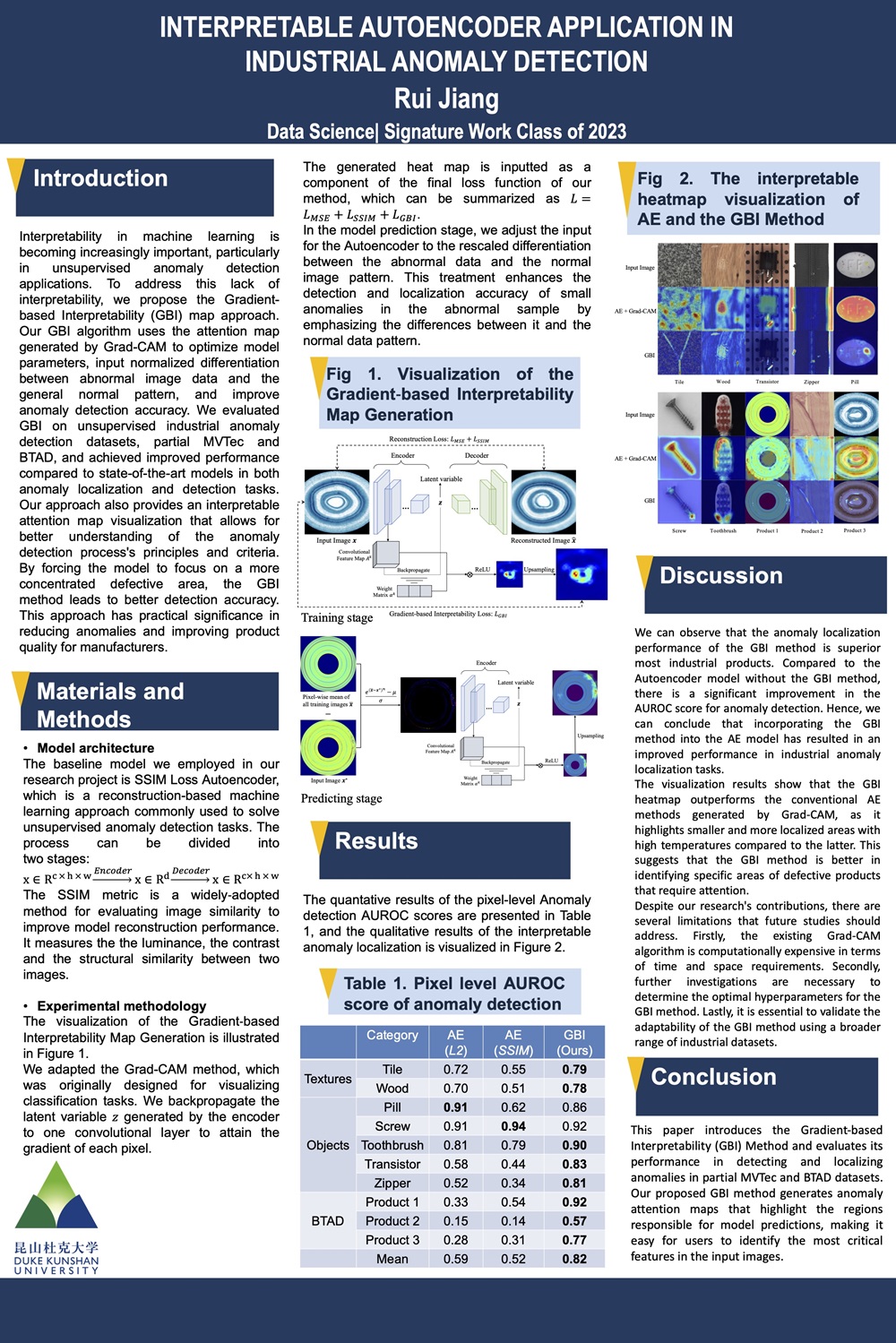
Model interpretability has become an increasingly important field in machine learning, and our proposed Gradient-based Interpretability (GBI) map approach addresses the lack of interpretability in industrial unsupervised anomaly detection applications. The GBI algorithm uses the attention map generated by Grad-CAM as a loss component to optimize model parameters and input the normalized differentiation between abnormal image data and the general normal pattern for the final anomaly detection task. We evaluated the performance of the GBI model on the unsupervised industrial anomaly detection datasets partial MVTec and BTAD, and the quantitative results showed that our method improved the performance of Autoencoder in both anomaly localization and detection tasks compared to state-of-the-art models. Additionally, our method provides an interpretable attention map visualization, enabling audiences to understand the anomaly detection process’s principles and criteria. The GBI method forces the model to focus on a more concentrated defective area, leading to improved detection accuracy. The practical significance of applying the GBI method lies in assisting manufacturers in reducing the occurrence of anomalies and improving product quality.