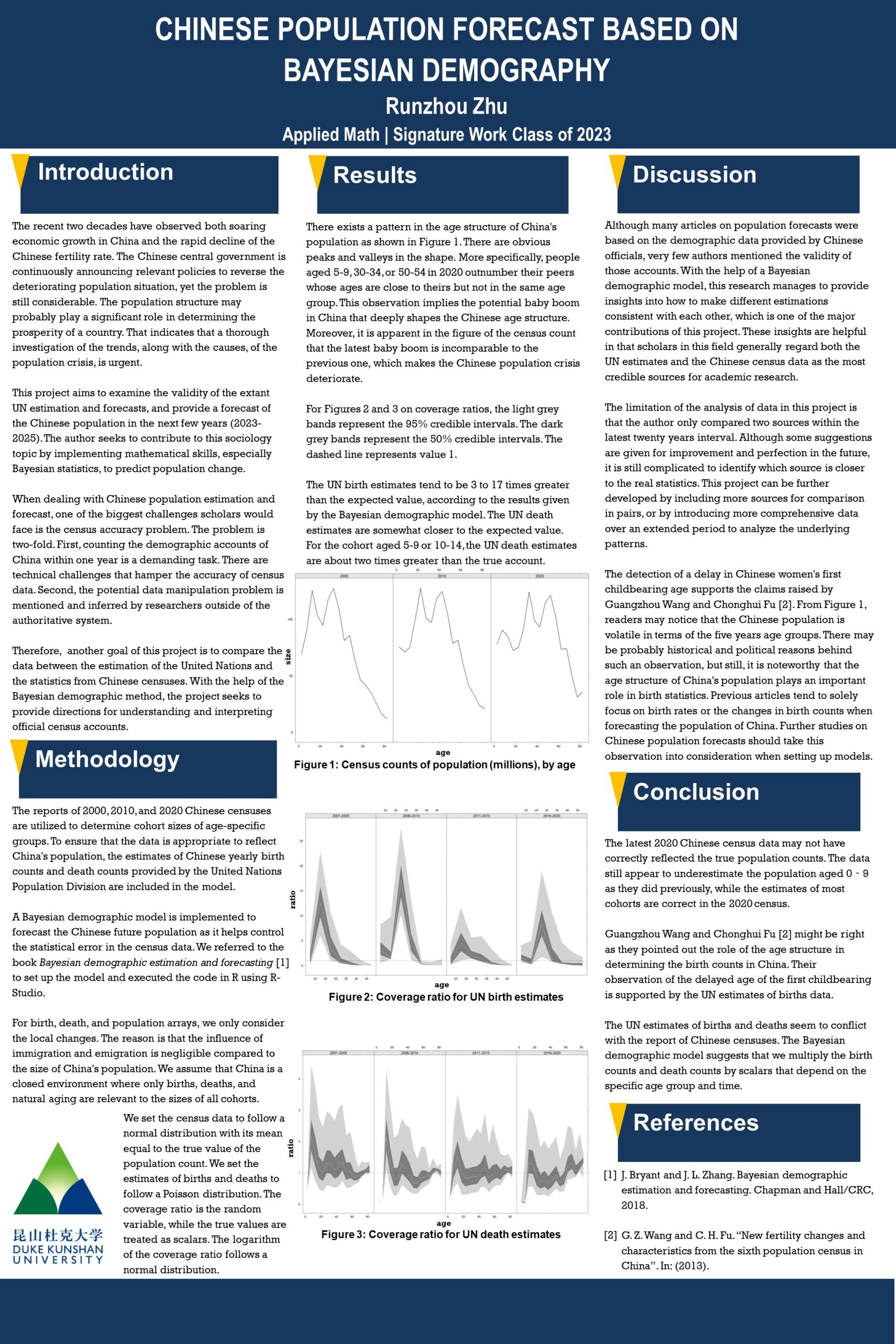
Chinese population forecast based on Bayesian demography
Name
Runzhou Zhu
Major
Applied Mathematics and Computational Science
Class
2023
About
Runzhou Zhu is from China. Interested in liberal arts education, Runzhou chose a demographic topic for his thesis, though he majored in applied math.
Signature Work Project Overview
China is facing an aging population problem and a fertility crisis. Among numerous studies on Chinese population estimation and forecasting, the United Nations (UN) Population Prospects is considered one of the most authoritative forecasts. As the Chinese census data are often questioned and challenged by scholars, there is a need for validation. The reseRuarch aims to examine the Chinese census data and the United Nations estimates of births and deaths in China by implementing a Bayesian demographic model. The Bayesian demographic model is based on the cohort component projection method, which is one of the most widely used methods in demography. The discrepancy between the Chinese census data and the UN estimates is found. The 2020 Chinese census data seem to underestimate the population aged 0-9, while the UN estimates seem to overestimate both births and deaths. Moreover, the results support the hypotheses that a) Chinese women delay their first birth and b) the age structure of the Chinese population is an important indicator of fertility. Suggestions are made for a quantitative revision of cohort sizes to more accurately reflect Chinese population conditions.